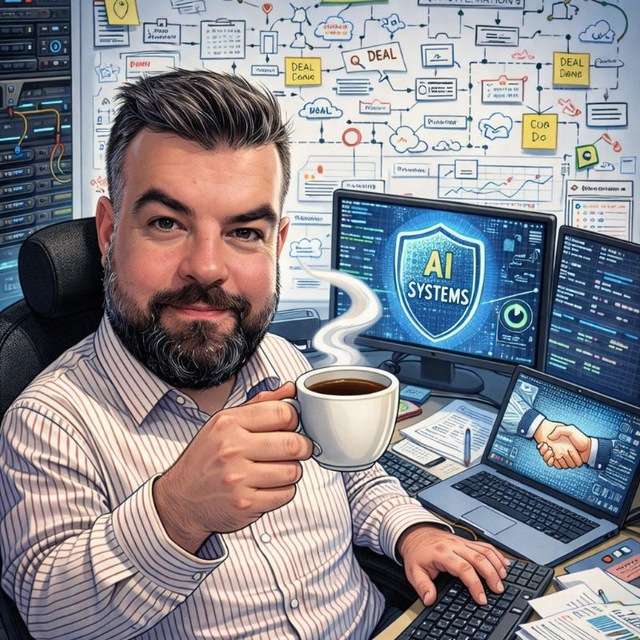
Two or three years ago it started with me copying text out of a chat window and pasting it into my documents. Back then it still felt like a handy trick, like a better Google. Today these systems have access to my files, edit them directly, control applications on my machine, and hold context across weeks. It works on Windows, Mac, and Linux, wherever I happen to be. The step from "copy-paste out of the chat" to "the system works with me, on my machine" never got a big announcement. It just happened.
I work like a different person today. And I'm still not sure whether I should be glad about that.
The Shift
Depth used to be the product. That sounds abstract, but I mean it concretely: if I didn't understand a problem, I had to spend time on it. Read articles, connect the dots, talk to people, try things, fail, try again. It was slow and sometimes frustrating. But at the end I had something that felt like real understanding. Knowledge that actually belonged to me, because I had earned it.
Today the process looks different. I frame a problem, iterate with an agent, get a result in minutes instead of days. That sounds like efficiency, and it is efficiency. But I haven't simply gotten faster. I've dropped into a different category altogether, and what that means for how I understand my own work occupies me more than I would have admitted at first.
What exactly that other category is took me a while to put into words.
The Amplifier
I don't use AI as a tool the way I use Excel as a tool. I use it more like an extension of my thinking. Ideas form in dialogue. Structure comes from outside. Knowledge is instantly available, before I even feel a gap forming.
It feels like a prosthesis for cognitive work. Not replacing it. Amplifying it.
But an amplifier doesn't distinguish between signal and noise.
If my thoughts are good, they get better. If they're bad, they get bad faster and louder. Over the past few months I've watched mediocre ideas turn into mediocre output at enormous speed. Just in an hour instead of a week. That's uncomfortable, because responsibility for the input stays entirely with me. The system doesn't turn bad questions into good answers. It just makes them bigger.
That pushed me to ask a question differently than I had before.
Does It Even Make a Difference?
For a long time I asked myself: what's actually still my achievement here?
I think that's the wrong question.
I ride an e-bike to work. I have no idea how the motor works in detail. I couldn't weld the frame, stitch the seat, make the grips, or design the disc brakes. I don't know the whole process chain, from raw material to finished bike. What I do know is how to use all those parts together to get from A to B.
It's the same with LLMs, just on a different level. I don't need to know how a transformer works internally. I don't need to understand the cloud infrastructure behind it that lets millions of people use these systems at once. I don't need to know the whole process chain, same as with the e-bike. I need to know how to use the system so it actually gets me where I'm going.
The goal, the judgment, the context, that stays mine. The ability to ask good questions, to spot bad output, to hold the direction. That's the competence that counts.
And if I actually wanted to understand the e-bike properly, I'm now in a better position than ever to learn that faster and more thoroughly, because I have tools that would help me do it.
Still, some unease remains. Because the next question is already waiting right behind it.
The New Dependency
What if I stop being able to find the goal on my own, too?
I couldn't do my job right now without LLMs. That's not a hypothetical scenario. It's a reality I had to admit to myself. And that tips something in how I think about my work.
Tools used to help me work. Today I work through the tools.
That reversal is small in wording. In meaning, it's large. And it keeps getting larger, the faster the field moves.
Speed as a Burden
I work in this field full time. I'm supposed to always be current. That's part of the job, part of how I see myself.
But my capacity is limited. Bound by projects, client meetings, personal life, just life. I've started carving out a full day a week, sometimes every two weeks, just to keep up with the latest developments and actually understand what's happening. A whole day. Just for that.
And even that barely covers it.
The strange part is: I probably feel this pressure earlier than most people, because I'm directly embedded in this field. Anyone not working with it daily still has some distance. But the distance keeps shrinking, for everyone.
I honestly don't know what the answer to that is. But I'm convinced that if no clear guidance shows up, no structures, no sensible onboarding paths, people will find their own way. Like a badly designed park where the paths are laid out so nobody uses them. Eventually desire paths appear. People just cut across, because the intended route is inconvenient, roundabout, and inefficient.
That's not a criticism of people. It's a comment on the design.
And somehow, it also describes my own inner state pretty well.
Between Two States
I swing between two states constantly.
On one side: maximum impact, new possibilities, the feeling of building things that used to require a whole team. That's real, and it's genuinely satisfying.
On the other side: constant acceleration, no stable footing, the permanent sense of having just fallen behind somewhere. That's just as real.
Neither state cancels the other out. They exist in parallel, and I haven't found a way to resolve that yet. What I do have is a question I can't shake anymore.
The Real Question
What does it even mean to be good at something, once the thinking itself is amplified?
I don't think the answer lives in the technology anymore. It lives in what I do with it. How I think. Where I steer. How I judge my own competence, not just my output.
This isn't a conclusion. It's a state.