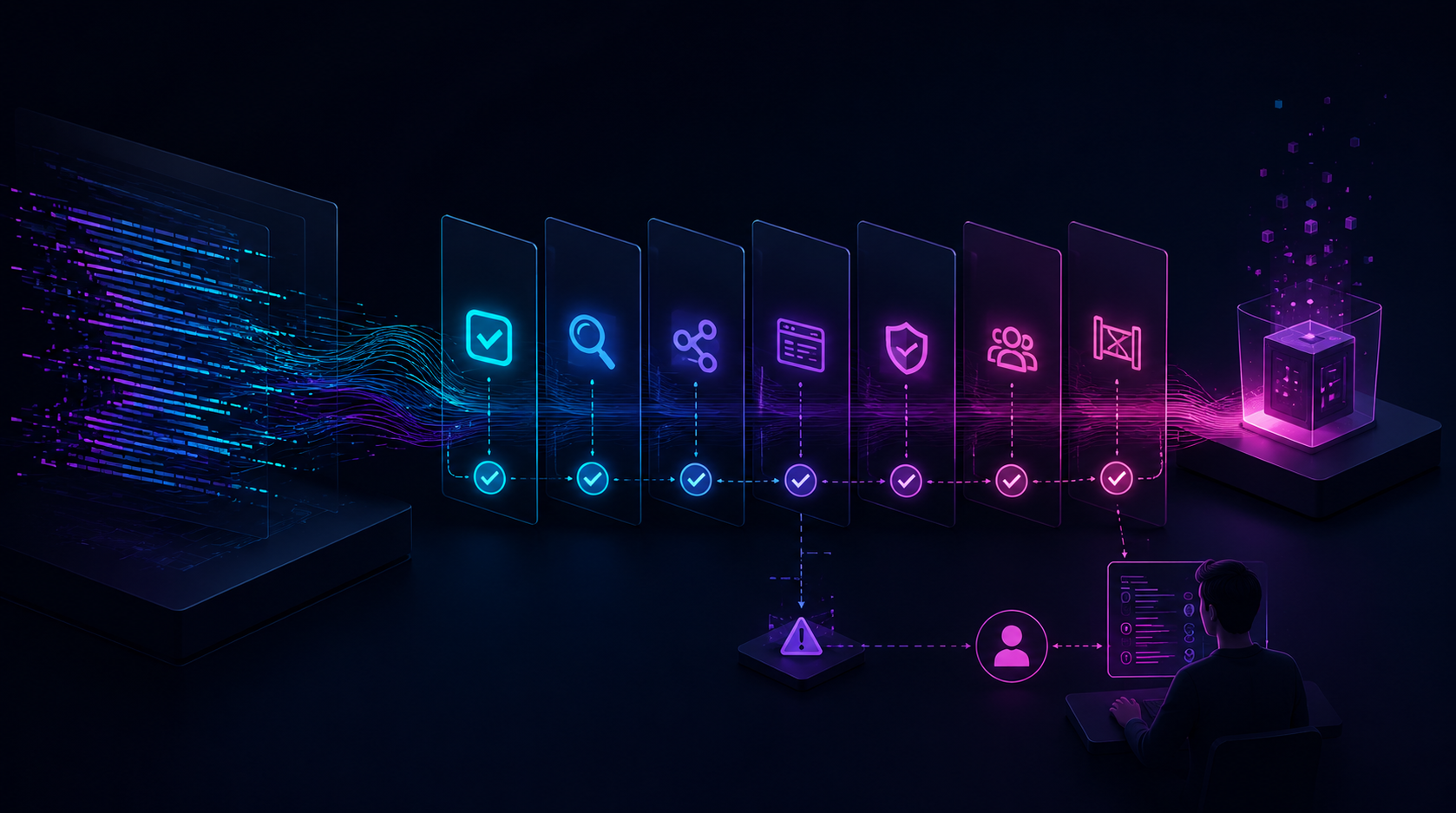

For a lot of software engineers, this is the hardest pill to swallow: you do not necessarily need to read every line of AI-generated code.
That sounds irresponsible, so let me make it precise. You do not need to read every line if your verification system is strong enough for the risk level of the change. That distinction is the whole argument.
I am not saying you should blindly ship whatever an AI agent produces. I am saying that "I personally read every line" is not the only possible quality bar. In many cases, it is not even the best one.
We Already Trust Systems, Not Lines
A non-technical CEO of an engineering company can sign off on a product launch without reading every line of code. An engineering manager can be accountable for a release without personally reviewing every implementation detail. Companies ship software in serious domains without having every executive inspect every diff.
Why? Not because everyone is reckless. Because trust is created by systems. Guardrails. Tests. Reviews. Static analysis. Quality management systems. Design controls. Formal verification where needed. Release gates. Monitoring. Rollback mechanisms. Audit trails. Separation of responsibilities.
Human code review can be part of that system. But it is not the whole system. And human review is not magic. How often did you approve a PR that later broke something? How often did a colleague leave two comments about naming and miss the actual bug? How often did someone review a change and still wave through the edge case that a single test would have caught?
This is not an argument against review. It is an argument against treating review as a holy ritual. The real question is not "did a human read this line?" It is "what gives us justified confidence that this change is safe enough to ship?" That is a very different question.
The Old Quality Bar Is Breaking
The classical mindset says: I need to read and understand every line before I can trust the code. I understand where that comes from. For a long time, code was written by humans, reviewed by humans, and shipped by humans, so human understanding became the default trust mechanism.
With AI-generated code, that mindset starts to break down. Not because understanding stops mattering, but because the volume and speed of generated code change the economics. If the AI can produce ten implementation attempts in the time it takes you to deeply review one, line-by-line review becomes the bottleneck.
And if every mistake has to be caught by your attention, you have not actually automated much. You have moved the typing to the AI while keeping the verification burden on yourself. That is not enough. The better approach is to move as much verification as possible into the system.
The Better Question
Instead of asking "do I personally think this line of code looks correct?", ask "what green checkmarks would I need to trust this change?" That one question changes the whole workflow.
For a UI change, maybe you need a browser test for the core flow. For a database migration, migration safety checks and a rollback strategy. For an API change, contract tests. For a security-sensitive change, human review plus static analysis plus targeted tests. For a translation change, locale key parity. For a refactor, the full test suite and a diff check that prevents forbidden dependencies from creeping back in.
The point is not that every change needs the same process. The point is that the process should be explicit. The quality bar should not be a vague feeling of "I looked at it." It should be a set of controls appropriate to the risk.
How We Use This In Practice
For products like Nodl and Zedl, we stopped treating "I read every line" as the quality bar. The agent's job is not to impress us with code we admire. Its job is to produce changes that pass the handoff gate.
For us, that gate is usually something like:
make check
That command runs the checks we care about: migration safety checks, static analysis, model and database constraint parity checks, and the full test suite. For important product flows, it also runs headless browser tests. If the gate is green, the change is usually shippable. If it is red, the agent loops until it is not.
The important part is not the command. It is what we put inside it. We follow a simple rule: enforce invariants with checks, not conventions. If something must never silently break, it needs an executable check. Encrypted file uploads. TLS to AI providers. Recurring job class names. Locale key parity. Model and database constraint parity. Core browser flows. Migration safety. Whatever matters for the product. If it matters, we try to move it from "someone should remember this" into "the check fails if this is broken."
Failure Messages Should Be Written for the Agent
This part is underrated. When humans write tests, we tolerate bad failure messages because a human can inspect the context and figure it out. But when an AI agent is inside the loop, the failure message becomes part of the interface.
A bad failure says "Test failed." A good failure tells the agent exactly what to do:
The German locale file is missing key dashboard.uploads.title. Add the missing key before completing the task.
The database column allows null, but the application model validates presence. Align the database constraint and model validation.
This diff introduces a new reference to postcss, which is forbidden during this migration. Remove the reference.
This changes the workflow completely. The agent no longer needs me to copy-paste error messages. It sees the error, understands the failure, fixes the code, and runs the checks again. That is the loop, and that is where AI coding becomes useful. Not because the model is perfect. It is not. Because the system around it makes mistakes cheap.
Human Review Is Still a Control
To be clear, I am not saying nobody should ever review AI-generated code. That would be stupid. There are areas where I still want human eyes: security-sensitive changes, payment logic, authentication, authorization, data deletion, complex migrations, anything with legal, medical, or financial risk, and anything where the verification system is not mature enough yet.
The point is not "replace all judgment with tests." The point is to stop using human judgment as the only verification layer for everything. For many changes, line-by-line review is the most expensive and least scalable way to catch mistakes. If a mistake can be turned into a test, a lint rule, a static check, a diff guard, or a browser assertion, do that. Then let the agent run into the wall by itself.
Every Mistake Is a Chance to Improve the System
Here is the operating loop I care about. Every time the AI makes a mistake and a human catches it, ask: can this class of mistake be made impossible, or at least cheaply detectable? If yes, add a check.
Do not just tell the AI "please don't do that again." It will do it again. Maybe not today, maybe not in the next prompt, but eventually. Prompts are weak. Checks are stronger. The goal is not to manually correct the same class of mistake forever. It is to turn repeated mistakes into executable guardrails.
That is how the process gets better. Over time, your system accumulates scar tissue. Every bug, every bad migration, every missing translation key, every unsafe dependency, every broken browser flow can become another check. This is how AI coding becomes less scary. Not because the agent becomes flawless, but because the process becomes harder to fool.
What I Actually Trust
When I ship AI-generated code, I am not trusting the AI as a person. I am not thinking "the model is smart, therefore this is fine." That would be nonsense. What I trust is the controlled process around it.
I trust the tests. I trust the static checks. I trust the migration safety checks. I trust the browser tests for the critical path. I trust the diff guards. I trust the fact that the agent was forced to run the same gate I would run myself. And when I do not trust those things enough, I review the code.
That is the balance. Human review becomes one tool in the system, not the entire system.
The Mindset Shift
The shift is not "stop caring about code quality." It is the opposite: stop relying on personal inspection as the main quality mechanism. Build a system that creates confidence, catches known failure modes, gives the agent fast feedback, makes mistakes visible before they reach production, and matches the risk of the change.
Then the question becomes less emotional. Not "did I read every line?" but "is the verification system strong enough for this change?" Sometimes the answer is no. Then read the code, add review, add checks, improve the gate. But often the answer is yes, and in those cases reading every line may not add much. It may just make you feel involved, and that feeling is not the same as safety.
The End State
I think this is where AI coding is going. Not toward blind trust. Not toward humans disappearing from software engineering. Toward a different trust model: the human designs the system of constraints, the agent operates inside it, the checks provide feedback, the agent loops, and the human intervenes where judgment, taste, risk, or missing verification still require it.
That is more interesting than arguing whether AI can code. In practice, the answer depends on what kind of code, what kind of task, and what kind of verification system surrounds it. If your only quality bar is "I read every line," AI coding will feel dangerous. If your quality bar is a controlled process with strong checks, AI coding starts to feel like automation.
That is the point. You do not need to read every line. You need to know what would have caught the mistake.
Who This Is For
- Engineers who feel guilty shipping code they did not read line by line, and want a defensible quality bar instead of a vague one.
- Engineering leads designing a review process for a team that now writes a lot of code with agents.
- Founders shipping with small teams who cannot personally inspect every diff and need the system to carry the load.
- Anyone in regulated or high-risk domains deciding which changes still demand human eyes and which can be gated by checks.
Frequently Asked Questions
Is it safe to ship AI-generated code without reading every line? It can be, when the verification system matches the risk of the change. Reading every line is one control, not the only one. Tests, static analysis, migration safety checks, diff guards, and browser tests can provide justified confidence. The real question is not whether a human read the line, but what would have caught the mistake if it were there.
When should a human still review AI-generated code? For security-sensitive changes, payment logic, authentication, authorization, data deletion, complex migrations, anything with legal, medical, or financial risk, and anything where the verification system is not mature enough yet. Human review stays a deliberate control for high-risk changes, rather than the default mechanism for everything.
What is a handoff gate? A single command, such as make check, that runs every check you care about before a change is considered done. On Nodl and Zedl it includes migration safety checks, static analysis, model and database constraint parity, the full test suite, and headless browser tests for critical flows. The agent loops until the gate is green.
Why write test failure messages for the AI agent? Because when an agent is inside the loop, the failure message is the interface. "Test failed" tells it nothing. A message that names the missing locale key or the mismatched database constraint lets the agent see the error, fix the code, and re-run the checks without a human copy-pasting stack traces.
What does "enforce invariants with checks, not conventions" mean? If something must never silently break, it should not live in a prompt or in someone's memory. It should be an executable check that fails when the invariant is violated. Every caught mistake is a candidate for a new check, so the system accumulates guardrails over time and becomes harder to fool.
How does this relate to the rest of the series? This builds on two earlier posts: that AI can code when verification is cheap, and that AI struggles when the verifier is a human's implicit taste. Reading less code is the practical consequence: move verification into the system, and reserve human attention for the risk and taste that checks cannot yet encode.